Essay · Music & Culture
The Romance of the Machine
On Kraftwerk, distance and connection

In July 2018, Kraftwerk were performing in Stuttgart when an astronaut joined them live from the International Space Station. Alexander Gerst had a tablet set up with virtual synthesisers, and together, with one of them in orbit and the others on Earth, they played Spacelab.
There is a lovely circularity to that moment. A track released in 1978, carrying all the quiet wonder its title suggests, had travelled far enough through time to pick up an accompanist in space. The future the record once imagined had become an actual place where someone could live and play along, and the same technology that carried Gerst away from Earth allowed him to reach back and join the music happening down below.
When I saw Kraftwerk live in Santiago with some close friends, what stayed with me was how completely the sound and the visual world belonged to one another. I remember the feeling of the whole evening much more than any isolated part of it. That is still what draws me to them: the way the music and the images fold together, leaving you with the sense that technology is not just something we use, but something we can genuinely enjoy spending time with.
There is a real romance in that. Out of mechanical sounds, repeated patterns, and synthetic voices, they draw out curiosity, pleasure, and longing. The precision is part of what makes it work. A rhythm keeps returning while a melody slowly threads its way through, and the precision itself begins to feel surprisingly intimate.
I think repetition is what opens that door. Once your ear settles into a familiar pattern, you have room to notice the smaller life inside it: a new sound arriving, a phrase lingering, or the quiet space just before a motif returns. The machinery gives the music a shape we can inhabit, and because that frame is so steady, even the smallest change feels generous.
On a track like Trans-Europe Express, that steady pulse becomes forward motion, carrying the promise of a destination. I like hearing the train in the song as more than just a machine. It brings to mind cities linked by a line on a map, landscapes slipping past a window, and the quiet thrill of arriving somewhere unfamiliar. The rhythm makes that daydream feel physical, so you can sit perfectly still and still feel yourself going somewhere. After all, a railway is built out of tracks, timetables, and steel, yet it also changes what feels within reach, turning a distant city into somewhere you might actually visit. You can hear the warmth of a connected Europe in the song without reducing it to a political programme; the music simply leaves room for you to imagine the trip.
With Computer Love, that sense of distance turns inward and becomes personal. The title pairs a grand technical promise with a very ordinary human wish: finding someone. To my ears, the electronic setting gives that longing a particular tenderness. The melody has room to be warm while the surrounding sounds stay crisp and measured, making the wish for connection feel almost exposed inside all that order.
It is easy, now, to hear the song as an early premonition of life lived through screens, though I am more moved by how little the feeling underneath needs explaining. We can build the most elaborate systems in the world for reaching one another and still sit there wondering whether anyone will answer on the other end. Making contact easier does not resolve the vulnerability of actually meeting someone, and that lingering uncertainty is what gives the song its emotional space.
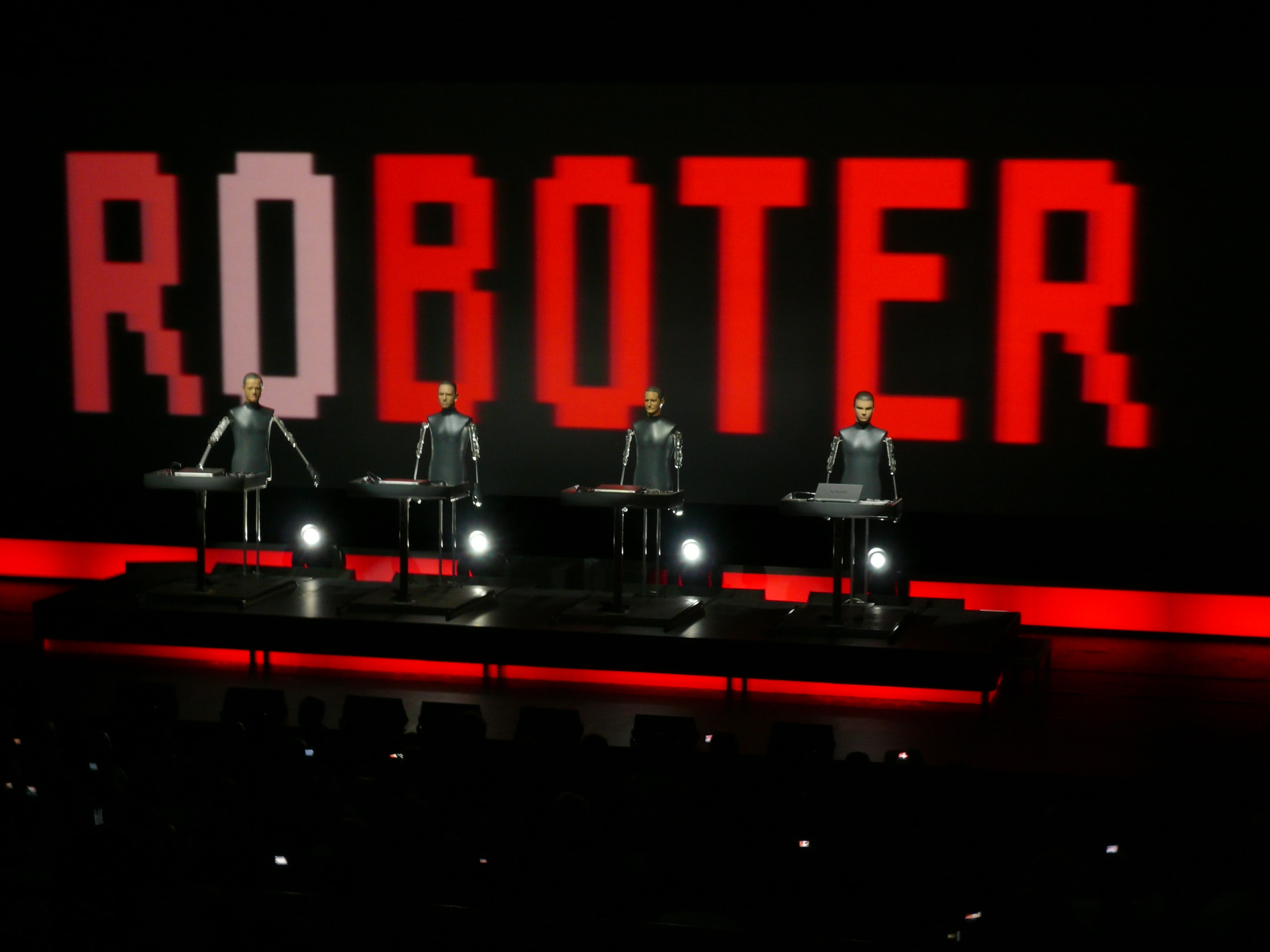
Still, these are only ways into the music, not heavy meanings it has to carry every time we put it on. Half the joy is right there on the surface, in the sounds themselves and the visual world around them. A song does not have to become an argument to matter.
Kraftwerk’s dry humour is part of that lightness, too. Asked in a 2005 interview whether drum machines have no soul, Ralf Hütter replied, "It depends on who is programming." With one line, the joke puts the human being right back inside the machine. In that same conversation, he spoke about holding onto an optimistic view of technology without ignoring its limits, pointing out that our anxieties about machines usually come down to who operates them and the social structures around them. It is a worldview spacious enough to hold both delight and clear-eyed judgment.
That balance matters to me, because finding a technology beautiful can be a way of paying closer attention to it. We can care about what a tool makes possible, take real joy in what people create with it, and still stay curious about the human choices behind it. Pleasure does not have to settle every other question.
Maybe that is why I keep returning to Gerst floating there with his tablet. There is something wonderfully playful about taking an extraordinary feat of engineering and using it just to join a song. For a few minutes, the space station was simply another room where a musician happened to be, and across all that distance, there was a part for him to play.